Tokyo and Moscow: An Unsuited Pair for Peace Negotiations
Written 13.03.2026
POLITICALHISTORYPOST-IMPERIAL
Stefan-Niko Tanskalainen
3/13/20262 min read
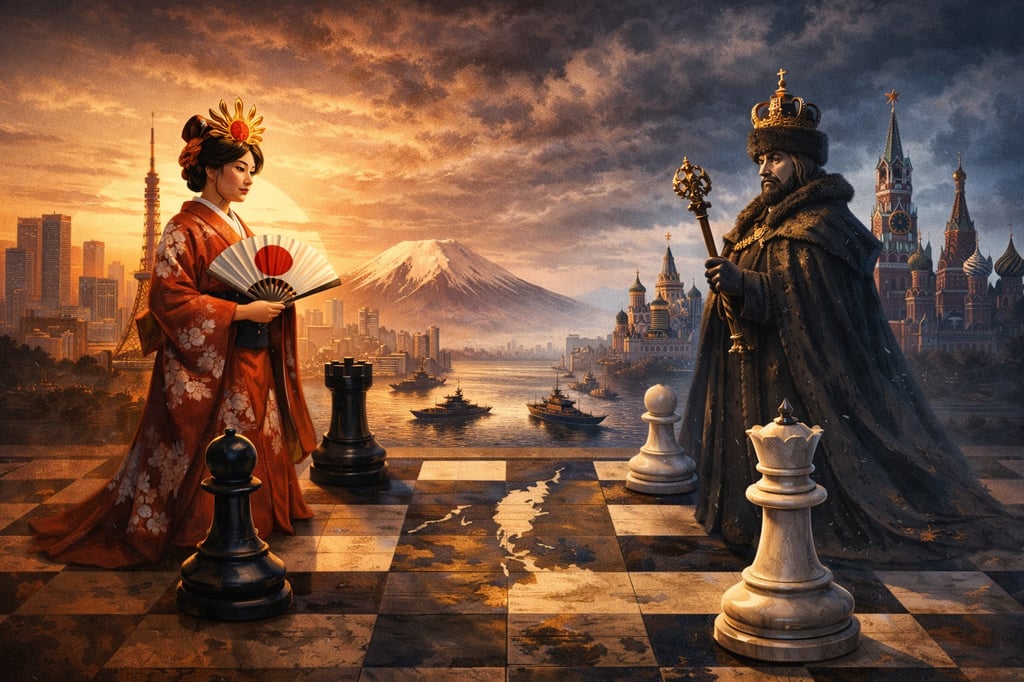

Peace negotiations between states are usually interpreted through legal, strategic, or economic frameworks. Yet diplomacy also has a cultural and symbolic dimension. Capitals themselves embody political traditions and historical archetypes that influence how negotiations are conducted. When examining the unresolved peace treaty issue between Russia and Japan after the end of the Second World War, the symbolic contrast between Tokyo and Moscow reveals an intriguing incompatibility.
Moscow as an Emotional Center of Power
Moscow historically represents the inner core of the Russian state. It grew as a political and spiritual center rather than a maritime or commercial hub. The city carries the legacy of centralized authority, religious symbolism, and the idea of a protective state.
In metaphorical terms, Moscow can be interpreted as embodying a protective and internalized political culture. Russian political tradition often emphasizes endurance, sacrifice, and the preservation of territorial integrity. Decisions emerging from Moscow tend to prioritize security, historical memory, and continuity of statehood.
Because of this orientation, negotiations conducted from Moscow often carry a defensive tone: the preservation of territory and sovereignty is seen not only as a strategic necessity but as a moral obligation.
Tokyo as a Maritime Strategic Capital
Tokyo, in contrast, developed as the center of a maritime state. Japan’s political culture historically combines disciplined hierarchy with outward economic and strategic orientation toward the sea.
Japanese diplomacy is therefore often pragmatic and structured, relying on clearly defined agreements and legal frameworks. In negotiations, Tokyo typically approaches issues through the lens of international law, economic cooperation, and strategic balance.
This difference creates a subtle mismatch with Moscow’s historically emotional and symbolic approach to sovereignty.
The Historical Alternative: St. Petersburg
The Russian Empire once possessed another diplomatic center: St. Petersburg.
Founded by Peter the Great, the city was deliberately built as Russia’s “window to Europe.” Unlike Moscow, St. Petersburg was designed as a maritime and diplomatic capital connected to European political culture.
Its political temperament could be described as colder, more strategic, and externally oriented. Imperial diplomacy conducted from St. Petersburg was often pragmatic and European in style.
It is no coincidence that many of the major treaties and diplomatic initiatives of the Russian Empire were negotiated through this northern capital.
The Problem of Symbolic Geography
When Tokyo negotiates with Moscow, the interaction occurs between two capitals that embody very different political archetypes:
Tokyo – maritime, legalistic, outward-looking
Moscow – continental, historical, sovereignty-focused
In symbolic terms, these two political cultures often speak different diplomatic languages.
Had negotiations historically been conducted through St. Petersburg, the interaction might have felt more symmetrical: two maritime capitals negotiating across the northern Pacific world.
The Territorial Dimension
The dispute over the Kuril Islands remains the central obstacle to a formal peace treaty between Japan and Russia following World War II.
For Japan, the issue is framed largely through legal arguments regarding territorial claims.
For Russia, however, the islands represent the outcome of the war and therefore part of the post-war international order. Any concession is interpreted domestically not merely as diplomacy but as a potential weakening of sovereignty.
This difference reinforces the structural incompatibility between the negotiation frameworks of Tokyo and Moscow.
Conclusion
Diplomacy is shaped not only by interests but also by political culture and historical symbolism. Moscow and Tokyo represent two different strategic traditions — continental endurance and maritime pragmatism.
Understanding these deeper symbolic differences may help explain why a formal peace treaty between Russia and Japan has remained elusive for decades.
Contact
Phone
anton.makela1@gmail.com
+358 40 196 43 61
© 2025. All rights reserved.
+7 901 729 53 72