The Nobel Prize and the Symbolic Capital of War
Written 15.03.2026
PRIZEPOLITICALHISTORY
Stefan-Niko Tanskalainen
3/15/20262 min read
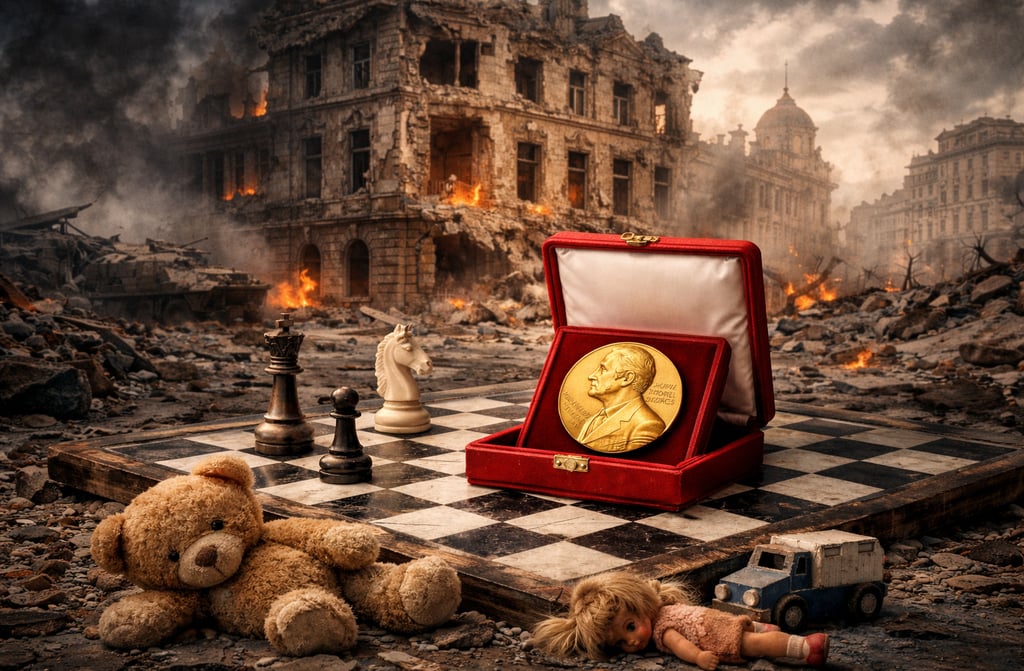
The Nobel Peace Prize has long ceased to be purely a moral act. In the twenty-first century it increasingly functions as an instrument of symbolic politics — a way of fixing a particular narrative about war, power, and moral legitimacy.
The case of Dmitry Muratov illustrates this problem clearly. The Nobel Prize was awarded to the editor of Novaya Gazeta as a symbol of independent journalism in Russia. Yet shortly afterwards the newspaper itself ceased to exist in its previous form under political pressure.
This raises a simple question: what exactly was awarded?
An institution — or its symbolic image?
After receiving the prize, Muratov sold his Nobel medal at auction. The proceeds were directed toward helping children affected by the war. The act was widely presented as a humanitarian gesture and received enormous media attention.
But this is where a more complicated question emerges.
If humanitarian gestures are viewed not only as moral symbols but also as political signals, a gap becomes visible between symbolic politics and institutional reality.
For several years of the war, the issue of evacuating civilians from combat zones remained a matter of complex administrative and political decisions. Mechanisms intended to protect children in dangerous areas developed slowly — through debates, legislation, and procedures that often appeared years after the conflict itself had begun.
The result is a paradox.
Global audiences witness powerful humanitarian gestures — auctions, charity campaigns, media narratives — symbolically directed toward helping children of war.
Yet the institutional mechanisms designed to protect those children frequently emerge much more slowly.
This gap turns the Nobel Prize into a particular political instrument. It creates a powerful moral image — an image of compassion, humanitarianism, and protection. But the real history of war rarely unfolds at the pace of symbolic gestures.
European history has seen moments when Nobel laureates themselves stood within tragic and complicated historical circumstances. One such figure was the Danish physicist Niels Bohr.
During the German occupation of Denmark, Bohr was forced to flee the country. His story became intertwined with the real drama of war — escape, rescue, and scientific exile.
Bohr’s history reminds us that Europe experienced wars in which human fates were decided not through media campaigns or symbolic acts, but through the harsh realities of historical events.
And against that background, the contemporary trajectory of the Nobel Prize appears increasingly strange: a prize created to reflect the moral weight of human decisions now often becomes part of the symbolic theatre that surrounds war.