The Limits of Dehumanisation and Britain's Post-Imperial Choice
Written 06.07.2026. Update 10.07.2026
POST-IMPERIALPOLITICS
Stefan-Niko Tanskalainen
7/6/20262 min read
The Limits of Dehumanisation and Britain's Post-Imperial Choice
One of the assumptions that has shaped parts of Western political discourse over recent years has been that sustained moral condemnation of Russia would gradually produce a broader public consensus against everything associated with it. This has often extended beyond criticism of the Russian state to cultural and historical perceptions of the peoples who once lived within the Soviet Union.
Whether that assumption is still effective is becoming an open question.
Many people in Britain appear increasingly capable of distinguishing between governments, wars and ordinary societies. They may strongly oppose military actions while simultaneously rejecting the idea that entire nations should be viewed through a single moral lens. If that trend continues, political strategies based primarily on moral polarisation may become less persuasive domestically.
At the same time, Britain itself is entering a period of profound internal transformation.
Large-scale immigration, economic pressures and constitutional debates have created a society that differs markedly from the Britain of previous decades. A government may seek to revive elements of national purpose or international leadership, but rebuilding a coherent national project becomes increasingly difficult when the country's social composition is changing rapidly.
This raises a broader strategic question.
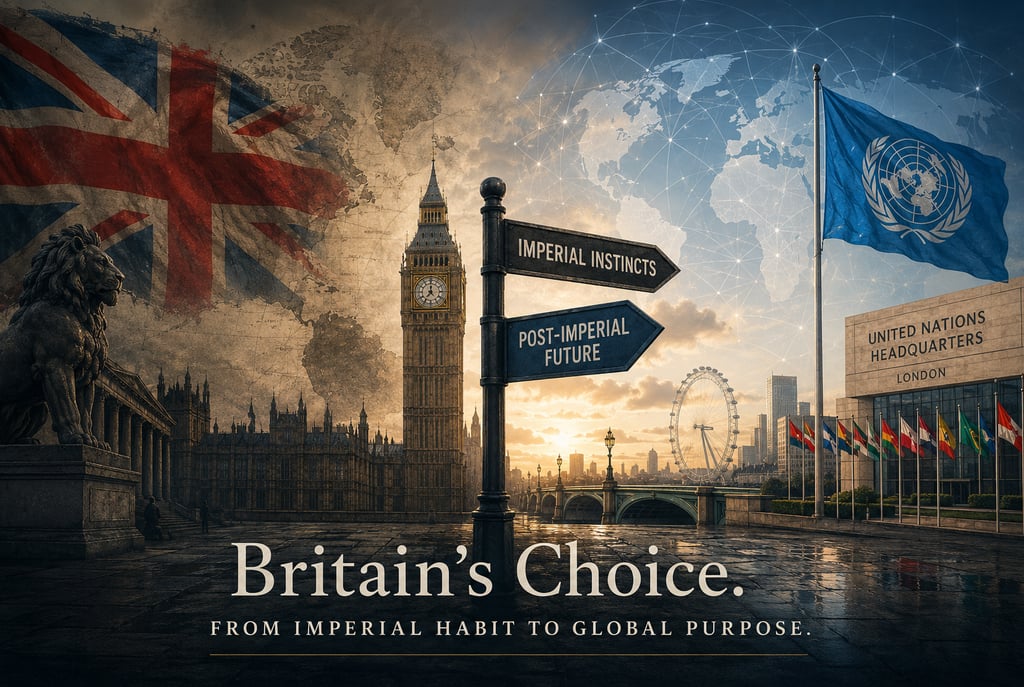
Can Britain continue acting through inherited imperial instincts while its own society is being fundamentally reshaped?
If no new post-imperial framework emerges, there is a risk that foreign policy will increasingly be driven by symbolic demonstrations of resolve rather than by sustainable long-term strategy. History shows that great powers sometimes become drawn into limited external confrontations that carry significance well beyond their military scale. Whether future crises resemble past conflicts is impossible to predict, but history demonstrates that unresolved structural tensions often reappear in unexpected places.
A different path would be to redefine Britain's international role rather than attempt to recreate earlier ones.
One ambitious possibility would be for Britain to position London as an even stronger centre for international diplomacy. In theory, strengthening global institutions—or even proposing that the United Nations' principal headquarters be relocated to London—would represent a fundamentally different vision of leadership: one based less on imperial inheritance and more on mediation and institution-building.
Whether such proposals are politically realistic is another question entirely. Yet the broader principle remains relevant. If Britain wishes to shape the twenty-first century, its greatest opportunity may lie not in managing old rivalries but in designing institutions capable of reducing them.
That would be a genuinely post-imperial project and until then US politics would mock and belittle UK by invading UK politics criticizing all failures that will appear in time. Time flow is paradoxically limited and UK feels that "its sailing in storm for too long with unstable captain". I mean by unstable captain that there were that many PM with that short period of time.