The Limit of Service
A Cultural Reflection after Watching Ponies. Written 11.03.2026
POST-IMPERIALTRADITIONPAINKILLER
Stefan-Niko Tanskalainen
3/11/20262 min read
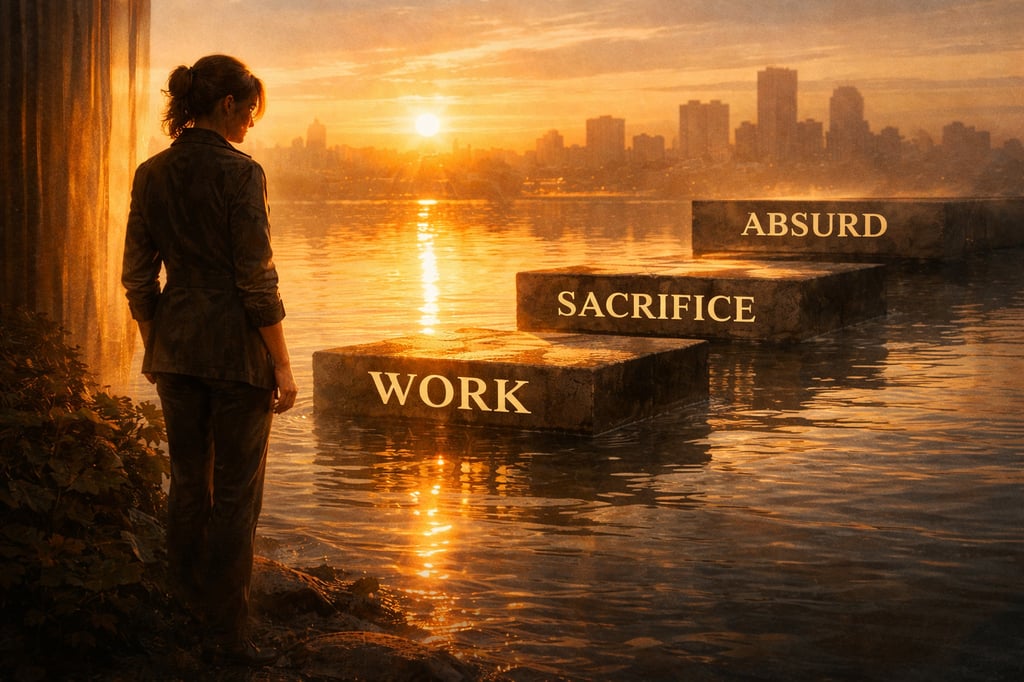

In one of the scenes of the recent series Ponies, the character played by Emilia Clarke faces a quiet but profound moral question: Should she go all the way?
Earlier in the narrative, the character hesitates. She senses that the path she is taking may require crossing a line — a personal boundary that cannot easily be restored once it is gone.
Yet she proceeds.
In a later scene she finds herself in a bathroom with a KGB agent, washing him in a bathtub. Nothing violent happens. There is no blood, no shouting, no overt cruelty. On the surface it is almost a domestic gesture — an act of care, or perhaps simply the completion of an assignment.
But symbolically the scene carries a different weight.
It depicts the moment when a person continues a task even after the internal question has already appeared: Should I stop?
For viewers from different cultural traditions, this moment resonates differently.
In the historical experience of United Kingdom, particularly after the long transformation of the British Empire into a post-imperial society, an important cultural principle emerged: service must have a limit.
A soldier may sacrifice much.
An intelligence officer may risk everything.
But there exists a silent boundary where duty must confront meaning. If service continues beyond that point, it no longer appears as courage. It begins to resemble absurdity.
This principle did not arise from weakness. On the contrary, it emerged from centuries of imperial experience: when power extends too far, the human being inside the system must retain the ability to stop.
The scene in Ponies becomes interesting precisely because it captures the tension at that boundary.
The character does not fully understand whether she should continue — yet she does. The gesture of washing the agent becomes symbolic: service persists even after the moral question has appeared.
For a British actress like Emilia Clarke, performing such a moment may feel uncomfortable in a deeper cultural sense. Not politically, but civilizationally. The British tradition carries a strong instinct that dignity requires knowing when to stop.
If this scene provokes discomfort — even something like “pain in the bones,” as one might poetically say — that reaction itself is meaningful.
It is the cultural memory of a limit.
And that limit is precisely what many twentieth-century political systems attempted to erase.
After the Russian Revolution of 1917, a radically different model of service emerged in Russia. Earlier imperial traditions of duty had contained an implicit boundary: one served the state, but not beyond the point where the effort became meaningless or self-destructive.
The revolutionary system transformed this idea.
Service became unlimited.
Sacrifice itself was treated as proof of loyalty. The more one endured, the more virtuous the act appeared to the system. In such conditions, the question “Should I stop?” gradually disappeared from public life.
But civilizations cannot function indefinitely without limits.
A society may survive hardship, war, and enormous sacrifice. Yet if it loses the ability to recognize the moment when effort becomes absurd, the very people who sustain the state begin to disappear.
Seen in this broader context, the quiet scene in Ponies acquires an unexpected philosophical depth. It becomes a small illustration of a universal question:
How far should a person go in the name of duty?
The answer may differ between cultures.
But the survival of any civilization may depend on preserving the courage to say, at the right moment:
Enough.