The Lean Paradox: Why the Lean Coach Is Often the Opposite of Lean
What means inner circle and why you cant develop lean as consult/couch. Written 30.12.2025
TRADITION
Stefan-Niko Tanskalainen
3/7/20263 min read
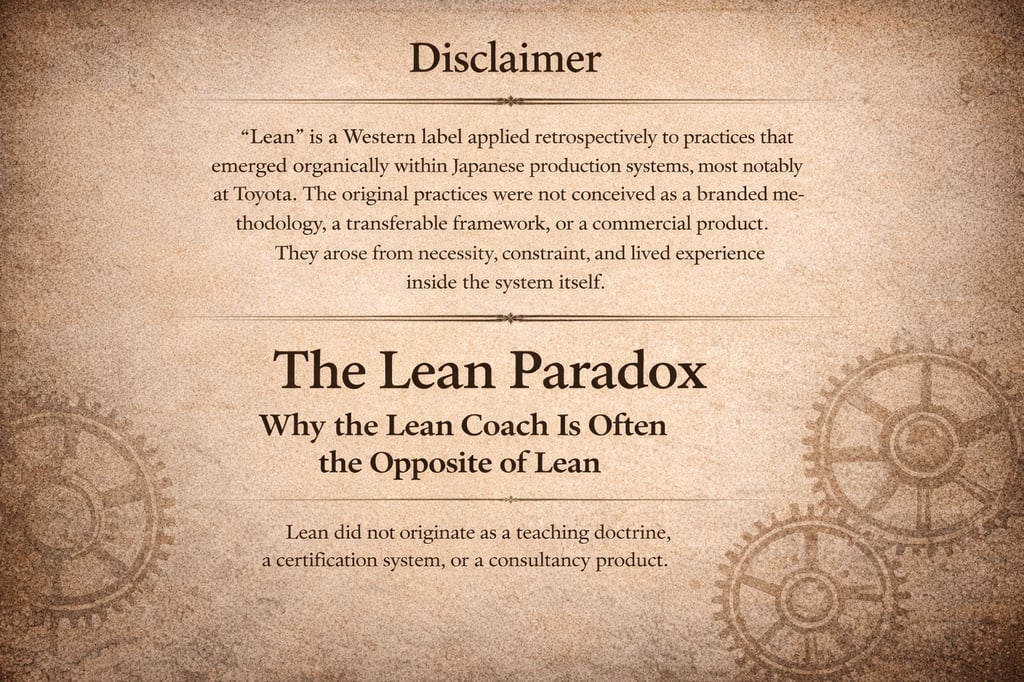
Disclaimer
“Lean” is a Western label applied retrospectively to practices that emerged organically within Japanese production systems, most notably at Toyota.
The original practices were not conceived as a branded methodology, a transferable framework, or a commercial product.
They arose from necessity, constraint, and lived experience inside the system itself.
This text does not reject Lean.
It questions whether Lean can remain true to its philosophical core once it is formalised, trademarked, and taught from the outside.
The Lean Paradox: Why the Lean Coach Is Often the Opposite of Lean
Lean did not originate as a teaching doctrine, a certification system, or a consultancy product.
It emerged from practical necessity — from the need to remove waste in order for a system to remain viable. Its purpose was not to explain reality, but to survive within it.
For this reason, Lean is, at its core, tacit knowledge.
It is not something that is transmitted; it is a state a system enters when inefficiency becomes intolerable. Lean appears when there is no longer room for excess.
Here lies the central paradox of modern Western Lean culture.
Once Lean is turned into a product — a training programme, a framework, or a consulting service — a new role is created: the Lean coach. And yet this role often stands in direct contradiction to the very philosophy it claims to represent.
Lean does not recognise hierarchy at the level of insight.
It does not assume a position from which one individual stands above the process and instructs others on how flow should be organised. Lean only emerges when a person is embedded within the flow and recognises waste in their own work. When someone arrives from outside to “teach Lean”, the foundational assumption is already broken: insight must arise internally, not be imposed externally.
In Western implementations, this contradiction is often rationalised through diagrams, metrics, certifications, and lists of “best practices”. Lean becomes an abstract method detached from context. But Lean was never a universal model. It was a response to a specific situation. When conditions change, the manifestation of Lean must change with them.
This is why Lean coaching frequently becomes self-contradictory.
If Lean truly functioned as intended, a coach would not be required. The information is publicly available. The tools are simple. People would discover Lean on their own when inefficiency became visible and painful enough. The appearance of the coach often signals not readiness, but the opposite: a system still incapable of internal realisation.
The coach does not fail because they are wrong.
They fail because their existence reveals that the system has not yet reached the point where Lean can arise organically.
A similar paradox appears in another domain: quantum physics.
The quantum world is inherently non-linear, probabilistic, and context-dependent. Yet it is often approached through linear reasoning — by constructing increasingly complex models, chains of explanation, and computational abstractions. Paradoxically, the closer one attempts to get, the further meaning seems to retreat.
This does not mean that quantum physics is misguided, nor that Lean is flawed.
The issue lies in the position from which they are approached.
When an observer places themselves above a phenomenon — as explainer, controller, or authority — they lose contact with the state in which the phenomenon actually operates. Both Lean and quantum mechanics demand humility: the capacity to be part of the system rather than standing above it.
The most productive position, therefore, is neither coach, trainer, nor explainer — but catalyst.
A catalyst does not lead, teach, or sell.
It reveals a contradiction, asks a question, exposes waste — and then withdraws. If the system is ready, it responds. If it is not, no amount of explanation will force the transformation.
The original strength of Lean lies precisely here.
It does not require defenders, vendors, or authorities. It functions only when individuals themselves recognise that the old way no longer holds. Everything else is ornamental rationality — often a sophisticated form of waste.
In this sense, Lean is neither a method nor a philosophy in the conventional sense.
It is a test.
If it spreads without coercion, it is authentic.
If it requires a coach, it has already lost its core.