Moscow's Tradition and the Fear of the Circle / Московская традиция и страх кольца
Written 07.06.2026
TRADITIONECONOMICSPOLITICS
Stefan-Niko Tanskalainen
6/6/20262 min read
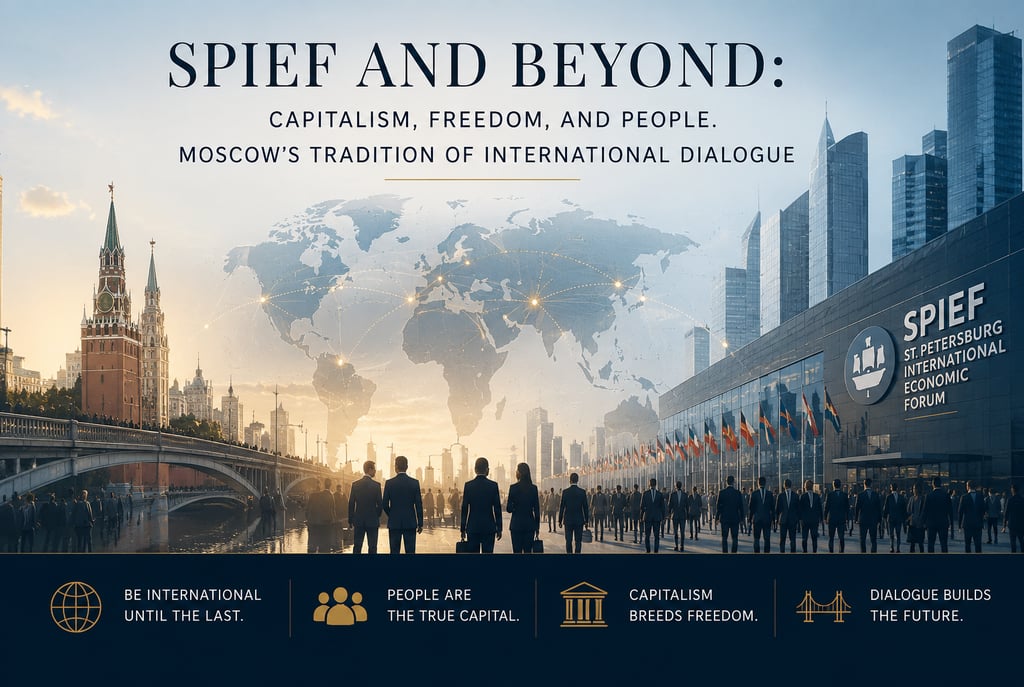
Moscow's Tradition of Internationalism
Every great city possesses more than an economy and a political system.
It possesses a character.
Saint Petersburg has always looked toward the sea. London toward trade routes. Vienna toward empire. Moscow, despite common assumptions, was never a completely closed city.
Its tradition was built around the attraction of people.
Merchants, engineers, artists, scholars, foreign specialists, diplomats, and travellers — for centuries Moscow drew in people from different backgrounds and places. That is why it can be described as a city of multitude.
But multitude is not simply a large population.
It is the ability to live among differences.
It is the ability to hear a foreign language without perceiving it as a threat.
It is the ability to remain oneself without demanding uniformity from others.
For this reason, Moscow's tradition can be expressed through a simple formula:
"Remain international until the very end."
Even when circumstances encourage the opposite.
Today, however, a question emerges: can this character endure through a prolonged conflict and a long-term weakening of connections with the outside world?
History suggests that economic restrictions rarely remain purely economic.
Gradually, they become cultural.
As trade connections diminish, the movement of people declines.
As the movement of people declines, the space for exchanging ideas narrows.
And when the exchange of ideas disappears, society increasingly begins to speak only to itself.
This is where the danger of the circle appears.
Not the danger of borders.
Not the danger of sanctions.
Not the danger of political pressure.
But the danger of a society becoming trapped within its own conversation.
The same arguments begin circulating within the same environment.
Eventually, society ceases to notice that it is speaking primarily to itself.
If such a process continues for decades, the fracture may appear not in the economy but in the city's tradition itself.
Moscow risks ceasing to be a city of encounter and becoming a city of repetition.
Yet this outcome is not inevitable.
As long as people continue to arrive.
As long as international exhibitions, conferences, and forums continue to take place.
As long as there remains a desire to engage with the outside world.
As long as there remains an interest in what exists beyond one's own borders.
For that reason, there is little value in looking with contempt upon those who come to Russia today.
Every individual follows a different path.
And if someone finds themselves here during such a complicated and contradictory period, that fact alone is significant.
Because internationalism does not live within state declarations.
It lives within people.
That is why the future of Moscow depends not only on Moscow itself.
It also depends upon whether the outside world remains willing to preserve at least the smallest bridges of communication.
Perhaps this is the deeper significance of international forums such as SPIEF.
Not contracts.
Not statistics.
Not political statements.
But an attempt to prevent the circle from closing completely.
У каждого большого города есть не только экономика и политика. У него есть характер.
Московская традиция муждународности
Санкт-Петербург всегда был обращён к морю. Лондон — к торговым путям. Вена — к империи. А Москва, вопреки распространённому мнению, никогда не была полностью замкнутым городом.
Её традиция строилась вокруг притяжения людей.
Купцы, инженеры, художники, учёные, иностранные специалисты, дипломаты, путешественники — Москва на протяжении столетий втягивала в себя самых разных людей. Именно поэтому её можно назвать городом многолюдья.
Но многолюдье — это не просто большое население.
Это способность жить среди различий.
Это способность слышать чужой язык и не воспринимать его как угрозу.
Это способность оставаться собой, не требуя одинаковости от окружающих.
Поэтому московскую традицию можно выразить простой формулой:
«Будь международным до последнего».
Даже тогда, когда обстоятельства подталкивают к обратному.
Сегодня возникает вопрос: способен ли этот характер сохраниться в условиях длительного конфликта и разрыва связей с внешним миром?
История показывает, что экономические ограничения редко остаются только экономическими.
Они постепенно превращаются в культурные.
Когда сокращаются торговые связи, уменьшается поток людей.
Когда уменьшается поток людей, сокращается пространство для обмена идеями.
Когда исчезает обмен идеями, общество начинает разговаривать главным образом само с собой.
Именно тогда возникает опасность кольца.
Не границы.
Не санкций.
Не политического давления.
А кольца собственного разговора.
Когда одни и те же аргументы начинают циркулировать внутри одной и той же среды.
Когда общество перестаёт замечать, что говорит само с собой.
Если такой процесс затянется на десятилетия, то надлом может произойти не в экономике, а в самой городской традиции.
Москва рискует перестать быть городом встречи и превратиться в город повторения.
Однако этот исход не является неизбежным.
Пока в город продолжают приезжать люди.
Пока проходят международные выставки, конференции и форумы.
Пока сохраняется желание разговаривать с внешним миром.
Пока существует интерес к тому, что происходит за пределами собственных границ.
Поэтому не стоит с пренебрежением смотреть на людей, которые приезжают в Россию сегодня.
У каждого человека свой путь.
И если кого-то занесло сюда в столь сложное и противоречивое время, это уже само по себе событие.
Потому что международность живёт не в декларациях государств.
Она живёт в людях.
Именно поэтому вопрос о будущем Москвы сегодня зависит не только от самой Москвы.
Он зависит и от того, останется ли внешний мир готовым поддерживать хотя бы минимальные мосты общения.
Возможно, именно в этом заключается настоящий смысл международных форумов вроде ПМЭФ.
Не в контрактах.
Не в цифрах.
Не в политических заявлениях.
А в попытке не дать замкнуться кольцу окончательно.