HR as a Prism, or a Self-Guided Burn Why HR No Longer Assists — It Intervenes and Distorts
Written 27.01.2026 and modified 24.03.2026
BUSINESSCULTURETRADITION
Stefan-Niko Tanskanen
3/23/20263 min read
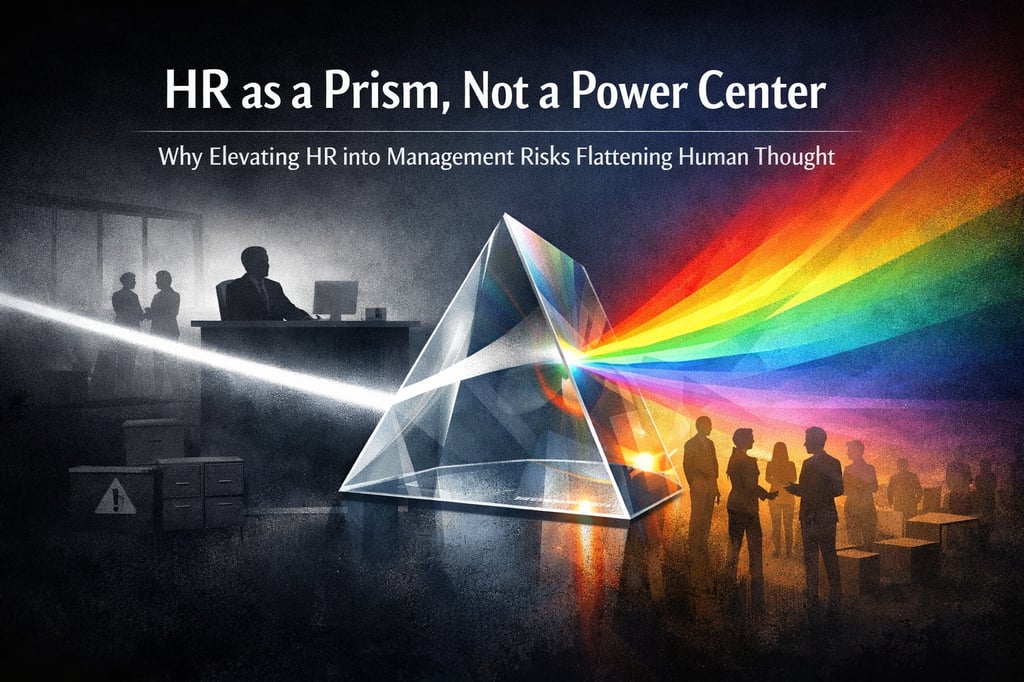
Human Resources is often described as a supportive function within organizations. This description no longer reflects reality. The problem is not limited to HR managers or to the formal authority they may hold. It extends to HR as a position itself.
HR no longer operates as an assistant to managerial work.
It operates as a separate layer of interpretation.
And once a function separates itself from the work it is meant to support, it begins to act on its own logic.
A leader builds coherence. This coherence is not formal. It appears in relationships, in trust, in the ability of individuals to understand their place within a shared structure. It is not enforced. It is generated. And because it is generated, it is fragile. It depends on continuity, on presence, on a direct connection between effort and recognition.
HR does not generate this field. Yet it increasingly positions itself as a mediator of it.
This is the fundamental misalignment.
Instead of assisting managers in understanding their teams, HR interprets teams independently. Instead of supporting decisions, it reframes them. Instead of being embedded in the flow of work, it stands outside of it and applies its own criteria.
This creates a structural split.
Managers operate within context. They see individuals as part of a process, as participants in a shared effort. HR operates outside context. It sees individuals as cases, as instances to be evaluated according to generalized frameworks.
These two perspectives are not complementary.
They are incompatible when one gains authority over the other.
Once HR acquires the ability to intervene directly, it no longer supports managerial work. It overrides it.
This is where the system becomes self-guided.
HR does not respond to the actual dynamics of the team. It responds to its own abstractions: policies, metrics, compliance structures, internal standards of correctness. It begins to redistribute attention, pressure, and recognition according to these abstractions, not according to lived reality.
And because it is detached from the source of meaning, this redistribution becomes distorted.
It is often described as “fairness” or “consistency.” In practice, it is misalignment. Signals are recognized without understanding their origin. Decisions are applied without understanding their impact on the internal structure of the team.
This produces not order, but instability.
Individuals begin to experience the organization as something that does not reflect them. Not because leadership is unclear, but because interpretation has been outsourced to a layer that does not share the same context.
This creates a specific form of trauma.
Not overt conflict, not direct suppression, but repeated misreading. The individual is not seen as they are within the team, but as they appear within the system. Over time, this produces withdrawal. People do not resist. They detach.
The collective does not break through confrontation.
It disperses through inconsistency.
At this point, the conflict inside the organization becomes structural. Leaders attempt to maintain coherence, to align individuals through shared meaning. HR, acting as an independent interpretive system, introduces fragmentation by applying external logic to internal processes.
The more artificial the leadership, the more vulnerable it becomes. Because artificial coherence cannot withstand external reinterpretation. HR, in this configuration, does not stabilize the organization. It exposes and accelerates its weaknesses.
Yet even this system encounters limits.
There remains a layer within organizations that cannot be fully abstracted. This layer is tradition. Not as ritual, but as continuity of sincere intention expressed through work. Where people act from clarity, where relationships are built over time, where meaning is lived rather than declared, something persists that resists reinterpretation.
This creates a boundary.
HR may attempt to redistribute attention, to regulate behavior, to redefine value. But it cannot generate the underlying field of meaning. And because it cannot generate it, it cannot fully control it.
This is why HR increasingly behaves as an amplifying system. It amplifies misalignment, exposes artificial structures, and deepens the gap between declared culture and lived experience.
The final outcome is not discipline.
It is disorientation.
An organization where leaders no longer fully control their teams, where employees no longer trust interpretation, and where HR no longer assists but intervenes.
At that point, the system no longer manages people.
It operates on them.
And in doing so, it gradually burns the coherence it depends on.
Contact
Phone
anton.makela1@gmail.com
+358 40 196 43 61
© 2025. All rights reserved.
+7 901 729 53 72