HR as a Prism, Not a Power Center: Why Elevating HR into Management Risks Flattening Human Thought
Overall Im for management assistants that are linked to concrete manager. Written 27.01.2026
BUSINESSPOLITICALCULTURE
Stefan-Niko Tanskanen
3/23/20262 min read
HR as a Prism, Not a Power Center: Why Elevating HR into Management Risks Flattening Human Thought
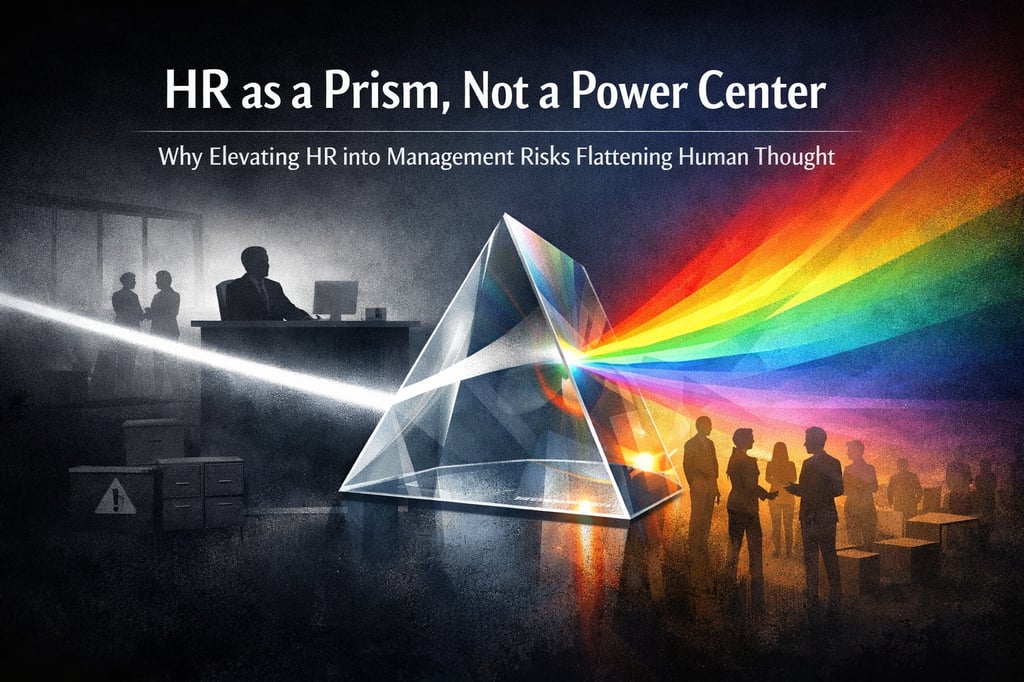
When Human Resources is imagined as a role between a “to-do” leader and a manager, it resembles a prism rather than a command post. A prism does not decide the direction of light. It reveals its complexity. White light enters, and a spectrum emerges — multiple colors, angles, and intensities that were always present but previously unseen.
This metaphor matters because it highlights what HR should do — and what it should not become.
The Original Function of HR: Interpretation, Not Authority
At its best, HR exists to translate between:
strategy and execution,
policy and lived reality,
organizational goals and human limits.
In this sense, HR is interpretive infrastructure.
It clarifies norms, resolves ambiguity, and helps individuals and leaders understand how abstract principles apply in concrete situations.
Crucially, this role does not require managerial power.
Once HR is granted formal authority over people — hiring vetoes, performance enforcement, disciplinary command — the prism begins to collapse into a filter.
From Prism to Filter: What Changes When HR Gains Power
A prism spreads light.
A filter blocks parts of it.
When HR is elevated into a managerial role, three structural shifts occur:
Policy replaces judgment
Individual cases stop being interpreted and start being processed.
The question shifts from “What is happening here?” to “Which policy applies?”Risk management overtakes human understanding
HR begins optimizing for legal defensibility, reputational safety, and procedural uniformity — not truth, growth, or nuance.Individuals become abstractions
People are no longer seen as complex agents but as variables within a compliance system.
In such a configuration, individual thought becomes a liability, not an asset.
Why Managerial HR Produces Organizational Flattening
Organizations often justify empowering HR by claiming it increases consistency and fairness. In practice, it frequently does the opposite.
Managerial HR incentivizes:
conformity over contribution,
silence over dissent,
compliance over creativity.
This creates a paradox: the department designed to “humanize” the organization becomes the mechanism that depersonalizes it.
The prism no longer refracts — it standardizes.
The Deeper Risk: Cultural Stasis
When HR becomes a power holder, culture freezes.
Why?
Because culture evolves through exception, not repetition.
Through edge cases, disagreements, and moments where existing rules are insufficient.
A powerful HR function, however, is structurally hostile to exceptions.
Its mandate becomes preservation, not evolution.
This is how organizations slowly drift into:
moral outsourcing (“HR will decide”),
leadership abdication,
and intellectual stagnation.
A Different Model: HR as Cognitive Infrastructure
Instead of granting HR managerial authority, organizations should treat HR as:
an advisory system, not a command chain,
a sense-making layer, not an enforcement arm,
a prism, not a gatekeeper.
In this model:
Leaders remain accountable for decisions.
Individuals retain agency.
HR supports reflection rather than replaces it.
This does not weaken organizations — it forces maturity.
Conclusion: Preserve the Spectrum
Power simplifies.
Understanding complicates.
Human systems require complication to remain alive.
If HR is allowed to remain a prism — refracting values, tensions, and perspectives — organizations retain color, depth, and adaptability.
If HR becomes a manager, the light narrows.
And eventually, it fades into policy gray.
Contact
Phone
anton.makela1@gmail.com
+358 40 196 43 61
© 2025. All rights reserved.
+7 901 729 53 72