How I Used AI to Build a Macroeconomic Thesis — And Why This Is the Future Skill Nobody Talks About
How AI orchestration works. Written 23.11.2025
AICOGNITIVE
Stefan-Niko Tanskalainen
3/7/20262 min read
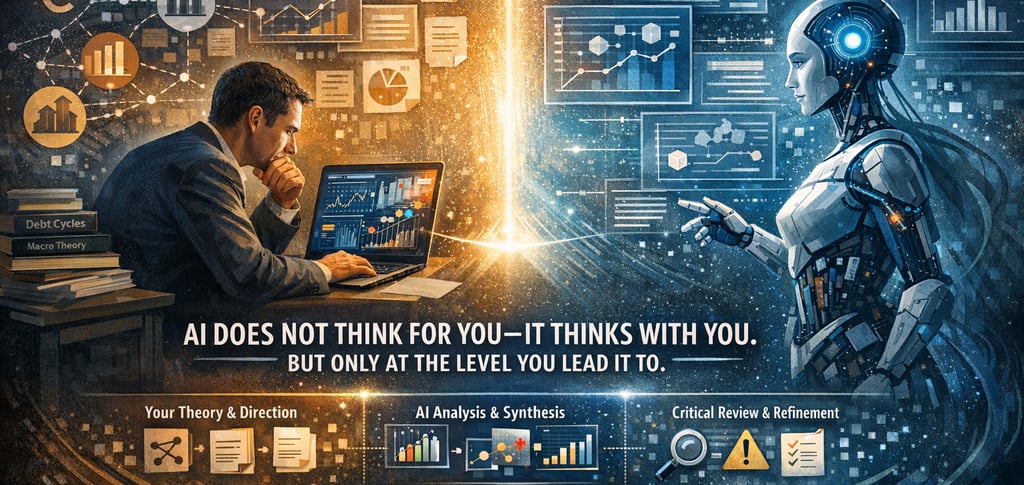
Artificial intelligence is transforming education and knowledge work, but not in the way people commonly assume. Public debate still focuses on whether students “cheat” with AI or whether AI should be restricted. Far less attention is given to the skill that will define the next decade: the ability to lead AI, not be led by it.
My thesis on Finland’s emerging double-deleveraging crisis — a complex macroeconomic phenomenon combining private- and public-sector balance sheet contraction — became a live demonstration of this new capability. The work was not a product of AI; it was the product of human-directed AI reasoning. Every insight originated from my own conceptual structure, while AI acted as a tool for sharpening, expanding and stress-testing that structure. What emerged was something uniquely powerful: a hybrid analytical process that neither human nor AI could have produced alone.
AI as an intellectual amplifier, not an author
The most important lesson from the process is that AI mirrors the thinker. When I approached it with incomplete ideas, unfocused prompts or vague conceptual direction, the output was equally unfocused. But when I provided a precise theoretical frame — Dalio’s deleveraging mechanisms, Eggertsson–Krugman’s double deleveraging collapse, Reinhart & Rogoff’s debt supercycles, Koo’s balance-sheet recession logic, and IMF sovereign-risk diagnostics — AI became capable of synthesizing, clarifying and connecting these frameworks at the speed I needed.
In other words:
AI does not create the theory. It pressure-tests the theory you bring to it.
It was my responsibility to define the macro structure of Finland’s situation, to recognise how private deleveraging and public fiscal exhaustion interact, and to determine which historical analogies satisfy the constraints of a eurozone economy without monetary sovereignty. AI simply followed my reasoning — and exposed weaknesses whenever the logic needed refinement.
This made the process intellectually demanding, not easier. AI accelerated thinking, but it did not replace the need for thinking.
The hidden skill: orchestration
The deepest skill I gained was not writing, but orchestration.
To use AI effectively, a researcher must:
define the conceptual frame,
impose structure on the argument,
know when to request synthesis and when to request expansion,
catch hallucinations,
guide style and tone,
and constantly check consistency with empirical evidence and theory.
In my case, I also used AI to build visualisations and simulate macro-mechanisms, which expanded my intuition for Finland’s debt dynamics. But the key point remains: I led the reasoning; AI followed.
This is why evaluating AI-assisted academic work with the question “Did AI help?” is outdated.
The real question is:
“Did the student demonstrate the ability to guide AI at a high analytical level?”
That is the true literacy of the 2020s.
What educators and institutions should learn
AI will not make humans obsolete — but it will make passive thinkers obsolete.
Educational institutions must shift from assessing “authorship” to assessing “conceptual leadership.” A student who delegates thinking to AI produces shallow, generic work. A student who uses AI as a cognitive exoskeleton produces deeper, more rigorous analysis than would be possible alone.
This is not cheating.
This is the future.
The principle that guided my entire process
The entire experience of constructing a macroeconomic thesis through AI-supported reasoning converges into one principle:
**“AI does not think for you — it thinks with you.
But only at the level you lead it to.”**
This is the new frontier of academic skill, policymaking intelligence, and professional competence. The sooner we embrace it, the sooner we unlock the real potential of human-AI collaboration.