Finland’s Banking System in a Balance Sheet Recession
We can question are Finland closer to death than life? Written 13.03.2026
ECONOMICSCULTURE
Stefan-Niko Tanskalainen
3/13/20264 min read
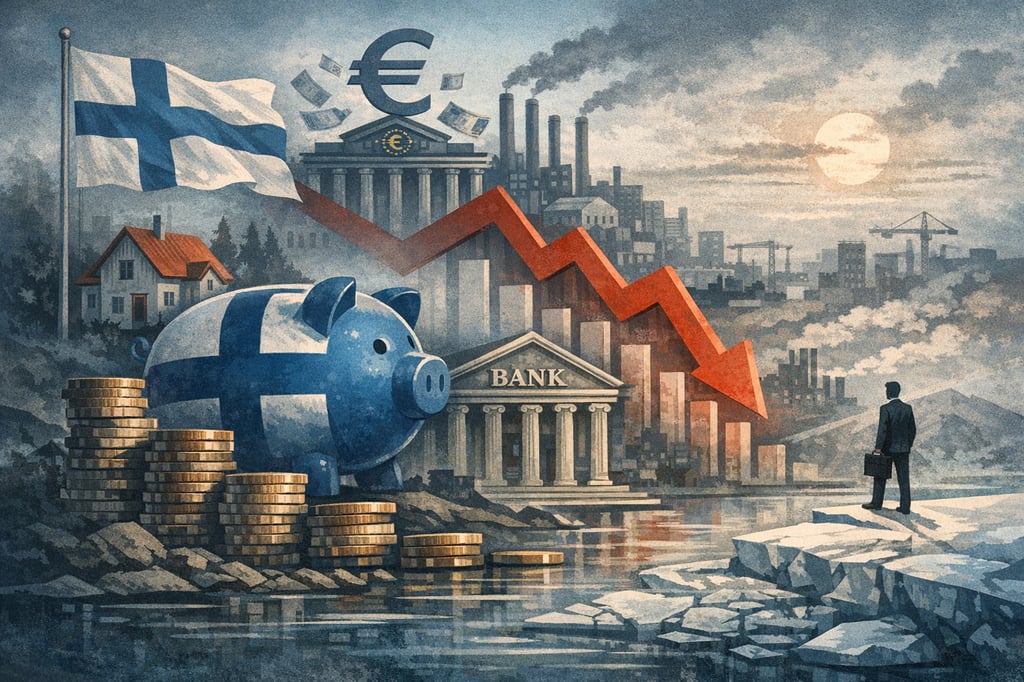
Why Capital Accumulates Too Slowly to Generate Economic Growth
Finland is widely perceived as one of the most stable financial systems in Europe. Banking crises are rare, default rates remain low, and households maintain a strong culture of financial discipline. Yet beneath this stability lies a structural paradox: the Finnish banking system generates new capital extremely slowly and therefore struggles to act as an engine of economic growth.
This paradox becomes particularly visible when the Finnish economy is examined through the framework of balance sheet recession, a concept introduced by the economist Richard Koo.
In a balance sheet recession, private actors—households and companies—prioritize reducing debt rather than expanding it. Even when interest rates are low and liquidity is abundant, the demand for credit remains structurally weak. As a result, the banking system faces a fundamental constraint: it cannot create capital through credit expansion if the private sector refuses to borrow.
The Architecture of Bank Balance Sheets
Finnish banks operate within the monetary framework of the eurozone and under the supervision of the European Central Bank. In theory, this provides access to ample liquidity and historically low funding costs. However, the composition of bank assets tells a very different story.
The balance sheets of Finnish banks are heavily concentrated in three areas:
residential mortgages
unsecured consumer lending
a relatively small volume of sovereign bonds
Unlike many banking systems in Europe, Finnish banks do not rely heavily on government bonds as a source of income. Finland historically maintained low levels of sovereign debt, and for many years the yield on government securities hovered around zero.
As a result, one of the traditional mechanisms through which banks accumulate capital—interest income from sovereign debt—has been largely absent.
The Deposit Paradox
At the same time, Finland presents another interesting phenomenon: households continue to accumulate substantial savings.
Finnish households hold significant amounts of money in bank deposits despite the fact that:
deposit interest rates have been near zero for long periods
banks offer little compensation for holding deposits
fees on deposits are generally minimal
This raises a key question: where do these funds actually go within a fiat monetary system if banks do not pay interest on them and do not visibly convert them into productive credit?
The answer lies in the mechanics of modern bank balance sheets.
When deposits enter the banking system, banks are not required to transform them immediately into loans. If credit demand is weak, liquidity can remain within the financial system and be parked in:
central bank reserves
short-term interbank operations
highly liquid financial assets
In this configuration, a large share of household savings effectively becomes idle liquidity inside the financial system, rather than funding new investment in the real economy.
Slow Capital Formation in the Banking Sector
In a traditional banking model, the cycle of capital creation looks like this:
deposits → loans → interest income → bank profits → capital accumulation
However, in Finland this cycle operates far more slowly.
The dominant asset class—mortgage lending—creates long-term, relatively low-margin assets. Consumer lending generates higher yields but is naturally constrained by credit risk and regulatory oversight.
The result is a banking system that accumulates capital gradually and cautiously.
This has several structural consequences:
banks expand corporate lending only slowly
investment in the real economy remains limited
the financial sector becomes structurally conservative
In other words, the financial system prioritizes stability over dynamism.
Cultural Effects of Financial Architecture
Economic structures rarely remain purely economic. Over time they influence social behavior and cultural expectations.
If capital formation is slow and entrepreneurial expansion remains limited, societies gradually adapt to a lower level of economic dynamism.
This may manifest in several ways:
reduced incentives for entrepreneurship
weaker demand for managerial and technological knowledge
a cultural orientation toward stability rather than risk-taking
Over the long term, such an environment may produce what could be described as intellectual stagnation within the economic system, where institutions maintain stability but struggle to generate new growth.
Progressive Taxation and Structural Constraints
Another important factor is the structure of taxation.
Finland operates one of the most progressive tax systems in Europe. In highly dynamic economies, progressive taxation can coexist with rapid capital formation and strong private investment.
However, when capital accumulation in the banking sector is already slow, progressive taxation can create additional pressure on:
entrepreneurial incentives
capital formation
the development of private investment structures
This tension highlights a deeper contradiction between the architecture of a Nordic welfare state and the requirements of modern capital markets, where private equity, venture capital, and rapid capital allocation play increasingly central roles.
Finland as a Case Study of Post-Crisis Economies
The Finnish case illustrates a broader challenge faced by many advanced economies after financial crises.
When societies enter a prolonged period of balance sheet repair—prioritizing savings over borrowing—the banking system loses its primary growth engine: credit expansion.
The result is a financial environment in which:
savings accumulate
capital grows slowly
economic dynamism weakens
This mechanism closely resembles the dynamics observed by Richard Koo in Japan after the 1990s asset bubble collapse.
In this sense, Finland may represent a European variation of the same structural phenomenon.
Conclusion
The Finnish banking system illustrates a paradox of modern financial architecture: high levels of savings do not automatically translate into strong economic growth.
The problem is not the lack of money, but the structure of balance sheets.
When:
households accumulate savings
firms avoid borrowing
banks have limited opportunities for profitable asset expansion
the financial system enters a state of slow capital formation.
Under such conditions, the key economic challenge is no longer the creation of liquidity, but the ability of the economy to transform accumulated savings into productive capital capable of generating long-term growth.