Finland, the Closed Border, and Europe’s Unfinished Post-Imperial Question
Written 13.03.2026
POLITICALPOST-IMPERIALPAMPHLET
Stefan-Niko Tanskalainen
3/13/20263 min read
Europe is still living inside the long shadow of its former empires.
The structures of the past did not disappear in 1945 or in 1991. They dissolved unevenly, leaving behind unresolved questions about identity, responsibility and historical continuity.
Many European states today are still trying to understand who they are after empire.
The United Kingdom is the clearest example. Brexit was not only a political decision about trade or regulation. It was also a psychological moment in which a former imperial center confronted the fact that it now stands alone in a different world.
Sweden carries another historical memory. Once a Baltic empire, it gradually transformed itself into a modern welfare state. Yet even today it still reflects on how closely it should tie its future to the European Union and whether its independence has been diluted.
The Netherlands historically represented a different model: a maritime trading society whose strength was openness. Its natural role in Europe has always been to keep routes open — between cities, ports and civilizations.
Germany still carries the burden of the twentieth century. Even after reunification, the country continues to navigate the legacy of division and the responsibility that comes from its history.
In the middle of these historical currents stands Finland.
Finland has always been a frontier society.
It developed at the intersection of Scandinavian, European and Russian historical worlds. The Finnish state emerged not in isolation but through long interaction with the Russian Empire and later the Soviet Union.
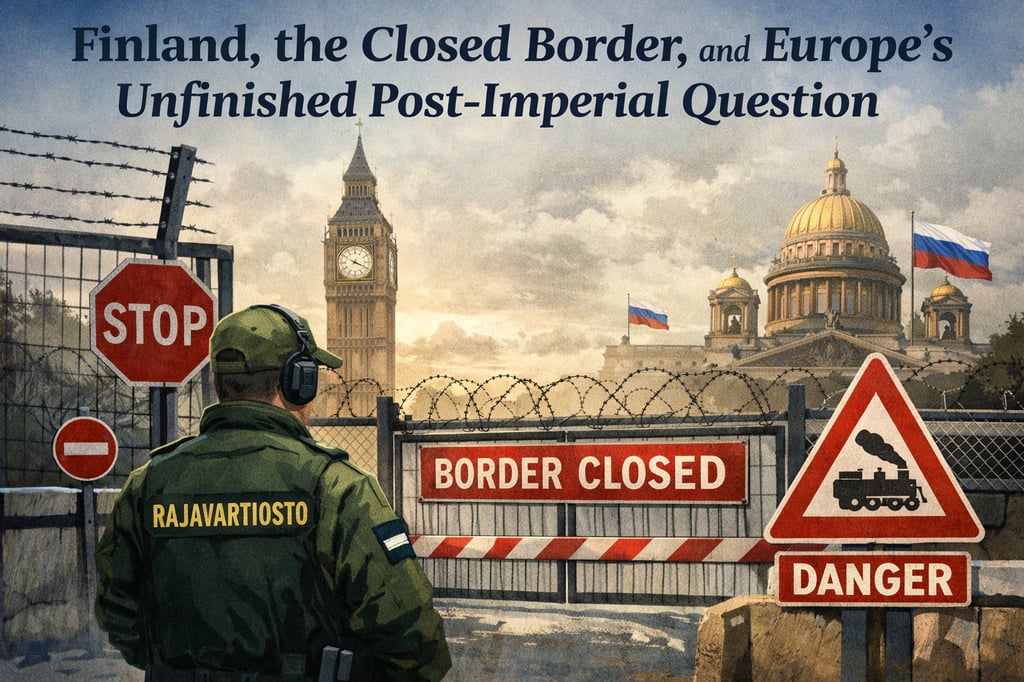
For this reason, the closure of the Finnish–Russian border is not merely a technical security measure. It is also a symbolic act that interrupts one of Europe’s most historically significant points of contact.
If Europe truly wants to move beyond the legacy of the Soviet system, then it must eventually confront the deeper question of Russia’s future identity. Russia, like many other former imperial powers, will one day need to reinterpret its past and construct a post-imperial narrative.
Such processes rarely happen in isolation.
They require contact, dialogue and places where historical experiences can meet without immediately collapsing into hostility.
When borders are completely sealed, societies stop seeing each other as complex historical communities. Instead they become abstractions — simplified images that are easily manipulated by fear or propaganda.
Finland historically had a different role.
For decades it demonstrated that it was possible to live at the edge of two worlds without erasing either one. Finnish society developed a political culture that understood both Western institutions and the historical depth of Russia.
Because of this experience, Finland could play an important role in Europe’s long transition beyond the Soviet past.
A closed border, however, eliminates this possibility.
Europe does not only need military alliances and economic sanctions.
It also needs spaces where historical transformation can occur without permanent isolation.
Finland could be one of those spaces.
But only if the border remains open.
Additional Historical Notes
Two historical observations are worth mentioning when discussing Finland’s current strategic choices.
First, Finland’s military culture has historically emphasized artillery as a central element of national defense. This emphasis reflected the realities of the twentieth century, when Finland relied heavily on territorial defense and large reserve formations. With Finland’s accession to the North Atlantic Treaty Organization, the strategic framework has changed. NATO operates primarily through integrated command structures, air power, intelligence coordination, and collective deterrence. In that sense, some elements of Finland’s traditional defense thinking reflect an earlier strategic era.
Second, Finland’s wartime history also includes morally difficult episodes that remain part of the country’s historical record. In November 1942, Finnish authorities handed over eight Jewish refugees to Nazi Germany, where they were subsequently deported to concentration camps. The event caused controversy even at the time and later became an important subject of national reflection about responsibility and moral choices during wartime.
These historical reminders do not diminish Finland’s achievements as a democratic society. Rather, they underline a broader point: European states carry complex historical legacies, and understanding those legacies is essential when discussing present political decisions and future roles in the transformation of Europe after the Soviet era.