Cultural clash in European politics and Social Cloth Under GDPR Regulation
Written 22.03.2026 edit 24.03.2026. Added Social Cloth Under GDPR Regulation 26.03.2026
JURIDICALCULTURETRADITION
Stefan-Niko Tanskalainen
3/22/20264 min read
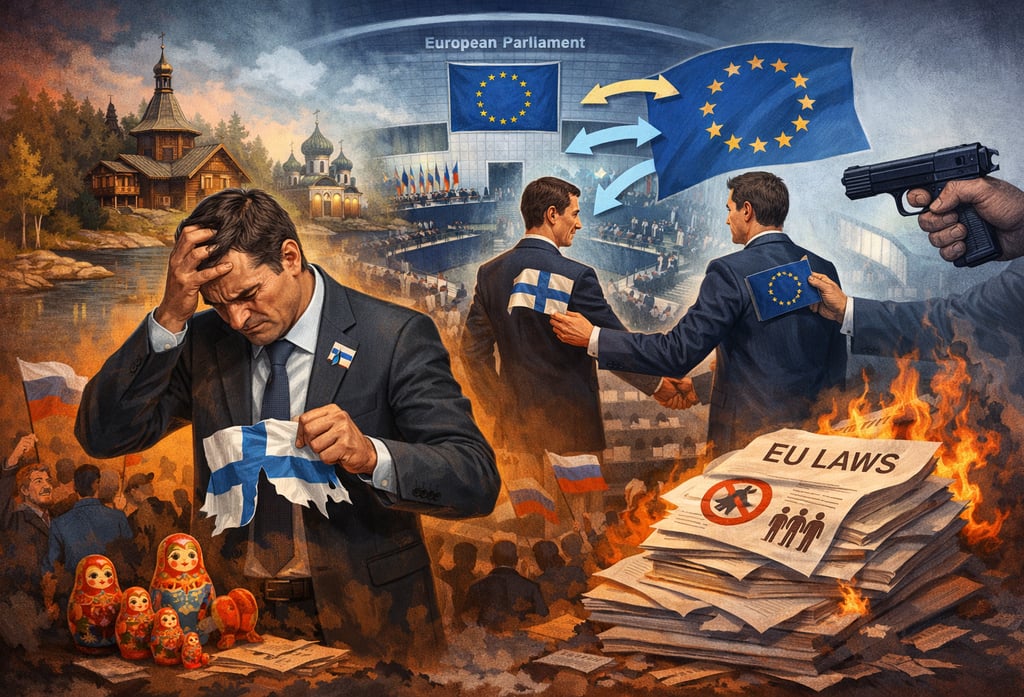
I would like to take a closer look at the situation in the European Parliament. Why does so much come out of it that feels harmful to culture and tradition, and is very difficult to process within national parliaments?
As I analyze in detail the situation with the Finns, I see that they are deeply traumatized due to poor historical decisions in terms of heritage. The risk with the Finns is that they are honest with those who voted for them in their country so that they could enter the European Parliament. However, in the European Parliament there is a possibility for elected candidates to change their party affiliation.
In the case of the Finns, this becomes an unfair move in relation to the competition of ideas and parliamentary principles. Many people in Europe have cultural ties with Russia, with Russians, and with Russian culture. The traumatic effect becomes accelerated, because the shift itself is traumatizing, and even the mere possibility of it acts like a gun to the head.
Therefore, a large share of the laws coming out of the European Parliament are essentially fictitious.
Social Cloth Under GDPR Regulation or: how Europe loses the scale of interaction
Introduction: not data, but a field
The General Data Protection Regulation (GDPR) is designed to protect data.
But human society has never existed at the level of data.
It exists within a field that simultaneously has memory, direction, and scale.
Memory retains past interactions.
Direction is shaped by intention.
Scale is determined by how far these interactions can extend and persist.
In this text, this field will be called the social cloth—
a woven structure of repeated, remembered, and recognized interactions.
GDPR intervenes precisely in this field, even though it formally regulates only information.
That is why its consequences appear not in data, but in the structure of the social cloth itself.
The city as an accumulation of intentions
A city does not emerge from architecture or planning.
It emerges from the intersection of human intentions.
A person enters a city not as a carrier of data, but as a carrier of direction:
to settle, to survive, to expand, to integrate, or to reshape the environment.
When these intentions are repeated, recognized, and remembered, they begin to form stable lines.
These lines intertwine and create what we call the social cloth.
Tradition is not a cultural text.
It is stabilized intention that has become recognizable.
Social cloth as a surface
The social cloth has size.
This is not a metaphor—it is a structural property.
It expands where:
interactions repeat,
recognition emerges,
memory is preserved,
and intentions can stabilize over time.
And it contracts where:
contacts are interrupted,
memory does not persist,
interaction starts from zero each time.
Its size is determined not by the number of people, but by the density of stable connections between them.
Millions may coexist in one space without forming a unified cloth if no durable lines of recognition connect them.
The paradox of contemporary Europe
Modern Europe is defined by mobility, open borders, and a high volume of interactions.
Yet a paradox emerges:
people move,
but their interactions do not form a shared trajectory.
Each contact becomes an episode rather than a continuation.
Each interaction exists as an isolated event rather than part of a history.
As a result:
a transnational cloth does not form,
despite population density and digital connectivity.
Regulation as a mechanism of contraction
GDPR does not destroy the social cloth directly.
It alters the conditions under which it forms.
Through data minimization, the right to erasure, and the requirement of continuous consent, it creates an environment where interaction loses memory.
When memory weakens, recognition disappears.
When recognition disappears, intention cannot stabilize.
When intention does not stabilize, it cannot become tradition.
Thus, contraction occurs:
the radius of social connection shrinks,
the depth of interaction decreases,
and the scale of the cloth stops expanding.
The separation of capitals
Historically, capitals functioned as nodes through which stable lines of interaction passed.
They connected different cultural spaces, forming a cloth that extended beyond national borders.
Today, this mechanism weakens.
Connections between capitals still exist, but they become:
formal,
regulated,
and deprived of accumulation.
Even with open borders and digital tools, no unified field emerges.
Instead, parallel and non-intersecting trajectories persist.
Genetics as a deeper layer
The human being is not only a social entity.
It carries a deeper structure—a biological predisposition toward interaction.
Genes do not determine culture directly, but they shape the capacity for:
recognition,
cooperation,
and long-term bonding.
Historically, humans evolved in environments where the social cloth was continuous.
Connections were repeated, reinforced, and transmitted over time.
In this sense:
human biological structure is adapted to a world
where interaction has memory and continuation.
The tragedy of interruption
When a person feels a pull toward another culture, another city, another social environment, a crucial process begins:
intention extends outward,
beyond the local context.
Historically, this led to the formation of new connections, new traditions, new lines within the cloth.
But when the conditions for connection are absent—when:
contacts do not stabilize,
memory does not persist,
interaction does not repeat,
a rupture emerges.
intention exists,
but it cannot become structure.
This is not decay in a biological sense, but in a structural one:
the capacity for sustained cooperation weakens,
the depth of connection diminishes,
and the individual remains in a state of unfinished interaction.
The city without depth
As these processes accumulate, a new type of city appears.
It contains:
people,
movement,
interaction,
but lacks accumulation.
It becomes:
neutral,
regulated,
and without internal character.
The city continues to function,
but ceases to produce tradition.
Conclusion
The social cloth does not disappear instantly.
It first loses its scale.
First, connections between capitals weaken.
Then, between cities.
Then, between individuals.
At a certain point, what remains is no longer a society,
but a system of interactions
that no longer forms a unified field.
GDPR protects the individual from leaving a trace.
But it is precisely the trace that allows interaction to continue.
Without continuation, there is no memory.
Without memory, no tradition.
Without tradition, no social cloth.
And society ceases to be a space of shared movement—
becoming instead a set of regulated,
but disconnected trajectories.