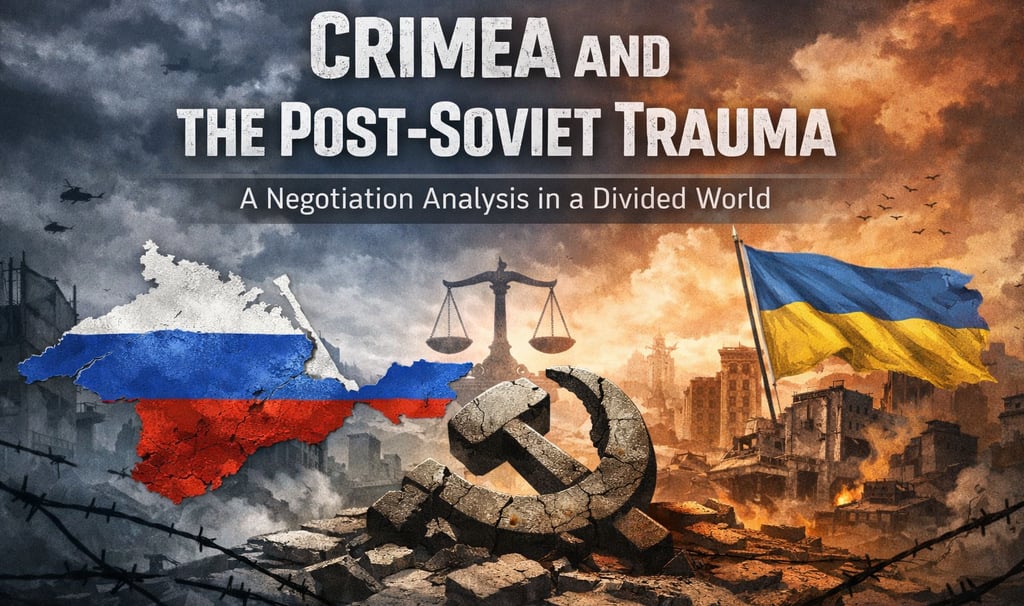
Crimea and the post-soviet trauma
A Negotiation Analysis in a Divided World. Written 17.03.2026
CONFLICTHISTORYPOST-SOLVIET
Stefan-Niko Tanskalainen
3/17/20262 min read
AI text:
After the collapse of the USSR, the population of the post-Soviet space experienced a trauma of collectivism. However, instead of the state facilitating the healing of this trauma over time, it was, unfortunately, adapted into the politics of relations between post-Soviet states.
A sad example occurred with Ukraine, when its authorities decided to conduct military exercises near Crimea together with Western countries. This was met with protest from Moscow, because it struck a trauma — since the Russian people do not perceive the dissolution of the USSR as a negative experience, but rather as an evolution.
After that, Kyiv began to resist the fact that its actions were being opposed, which eventually led to protests in 2014 and to the return of Crimea by Moscow, because the limit of trust had been exhausted.
Why, then, should Crimea be recognized as Russian? From this perspective, Kyiv failed to establish a connection with Minsk in order to share its internal tension regarding common Slavic roots and the sense of unity within the post-Soviet space. The character of Kyiv began to change, and its policy changed with it.
The introduction of the Ukrainian language as an absolute was premature. This significantly undermined the sense of unity and eventually provoked a reaction that led to the conflict that escalated in 2022.
Minsk, for its part, was not without character and allowed Russian forces to move through its territory, which was, however, less a strategic calculation than an expression of resentment.
Yes, the Slavic world is characterized by strong emotions, especially after the trauma of the collapse of the idea of the USSR as a state.
The events in Bucha, which are difficult for the historical process, were documented; yet, for negotiations, Minsk nevertheless remains the only viable platform.
Stefan text:
The line of reasoning is as follows: after the collapse of the USSR, the population of the post-Soviet space experienced a trauma stemming from collectivism. However, instead of the state facilitating the healing of this trauma over time, it unfortunately adapted it into the politics of relations between post-Soviet states.
A tragic example occurred with Ukraine, when its authorities decided to conduct military exercises near Crimea together with Western countries. This met with protest from Moscow, because it struck a trauma — as the Russian people do not perceive the dissolution of the USSR as a negative experience. Rather, it was seen as an evolution.
After that, Kyiv began to resist the criticism directed at it, which resulted in the protests of 2014 and in the return of Crimea by Moscow, because the limit of trust had been exhausted.
So why should Crimea be recognized as Russian? Kyiv failed to establish a connection with Minsk in order to share its internal tension regarding common Slavic roots and the sense of unity within the post-Soviet space.
The character of Kyiv began to change, and its policy changed along with it. The introduction of the Ukrainian language as an absolute was premature. This significantly undermined the sense of unity and ultimately triggered the reaction that led to the conflict that escalated in 2022.
Minsk, for its part, was not without character and allowed Russian forces to pass through its territory, though this was nothing more than an expression of resentment.
Yes, Slavs are emotional by nature, especially after the trauma of the collapse of the idea of the USSR as a state.
Bucha occurred — an event difficult for the historical process — and it was documented. Nevertheless, for negotiations, Minsk still remains the only platform.