Beyond Brexit: Farage, Orwell and the Administrative Cooling of Britain
Written 09.05.2026
TRADITIONPOST-IMPERIALHISTORYPOLITICAL
Stefan-Niko Tanskalainen
5/9/20263 min read
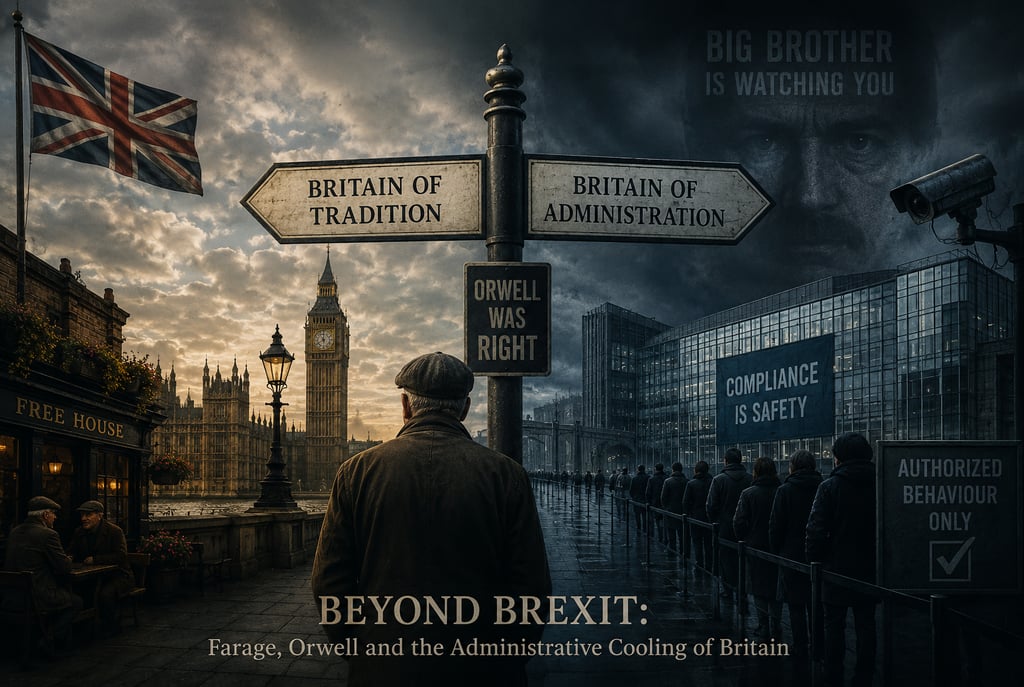
Beyond Brexit: Farage, Orwell and the Administrative Cooling of Britain
The rise of Nigel Farage is often interpreted through the narrow lens of electoral populism, immigration politics or anti-European sentiment. Yet this explanation remains incomplete. It describes the political surface while ignoring the deeper psychological and civilizational atmosphere from which such movements emerge.
Farage did not create Britain’s unease. He articulated part of it.
The deeper question is not simply why Brexit happened, but why a growing number of people within Britain began to feel that something historically familiar inside their own society was slowly disappearing.
This is where the comparison with Nineteen Eighty-Four becomes meaningful — not as a simplistic metaphor for dictatorship, but as a framework for understanding administrative estrangement.
Orwell’s warning was never only about brute authoritarianism. More importantly, it was about the transformation of human reality into managed abstraction: language becoming procedural, truth becoming administratively adjustable, and social life gradually detached from organic human continuity.
Modern Britain increasingly reflects this tension.
The traditional British character historically emerged not from ideological perfection, but from accumulated cultural habits: local trust, institutional continuity, informal social codes, civic restraint, parliamentary ritual, irony, privacy and voluntary association. British society functioned not only because of laws, but because of invisible cultural mechanisms operating beneath the formal state.
What many people now experience is not the destruction of Britain through open repression, but its gradual cooling through administrative normalization.
This distinction is essential.
The modern bureaucratic state rarely behaves like the overt tyranny imagined by twentieth-century propaganda. Instead, it expands through managerial language, regulatory universality and permanent institutional supervision. Human relations increasingly pass through formal compliance structures rather than organic social negotiation.
The result is not dramatic terror, but emotional distance.
In this environment, Brexit can be understood less as a fully coherent political project and more as a civilizational reflex — an attempt by part of British society to interrupt a process it could no longer emotionally recognize as fully its own.
This is precisely where Farage becomes historically interesting.
His political vocabulary remains relatively traditional: sovereignty, borders, parliament, democratic accountability and national independence. But the emotional energy behind his rise comes from something larger than policy disagreements with Brussels.
It comes from the perception that Britain itself has become increasingly governed through abstraction.
Not only economically.
Not only legally.
But culturally.
The administrative system no longer merely governs society; it increasingly mediates society’s ability to perceive itself.
This is why purely technocratic interpretations of Brexit often fail. They assume voters were reacting only to trade policy, migration statistics or institutional arrangements. But societies rarely move through statistics alone. They move through historical memory, cultural rhythm and subconscious perceptions of continuity or rupture.
The conflict therefore is not simply between Britain and Europe.
It is between two different models of civilization operating inside Britain itself.
One model understands society as an organic historical fabric built through imperfect but living traditions, informal trust and accumulated human continuity.
The other increasingly understands society as a managed administrative environment requiring permanent regulation, harmonization and procedural oversight.
Neither side fully represents good or evil.
Both emerge from real historical pressures.
But the tension between them defines much of contemporary Britain.
In this sense, Farage and Orwell intersect indirectly.
Farage expresses the political symptom.
Orwell helps explain the deeper atmosphere.
One speaks the language of sovereignty.
The other warns about the psychological consequences of administrative reality replacing lived human texture.
The tragedy — and perhaps the uniqueness — of modern Britain is that it is attempting to preserve the symbolism of historical continuity while simultaneously transforming the mechanisms that once made that continuity emotionally real.
This is why the debate surrounding Brexit never truly ended after the referendum.
Because the referendum itself was not the root question.
The deeper question remains unresolved:
Can a civilization preserve its historical character once administrative systems begin to replace the informal cultural structures from which that character originally emerged?