Against “Geopolitics”: A Pamphlet on a Category Error Disguised as Science
Written in january 2026
POLITICALHISTORYPAMPHLET
Stefan-Niko Tanskalainen
3/7/20262 min read
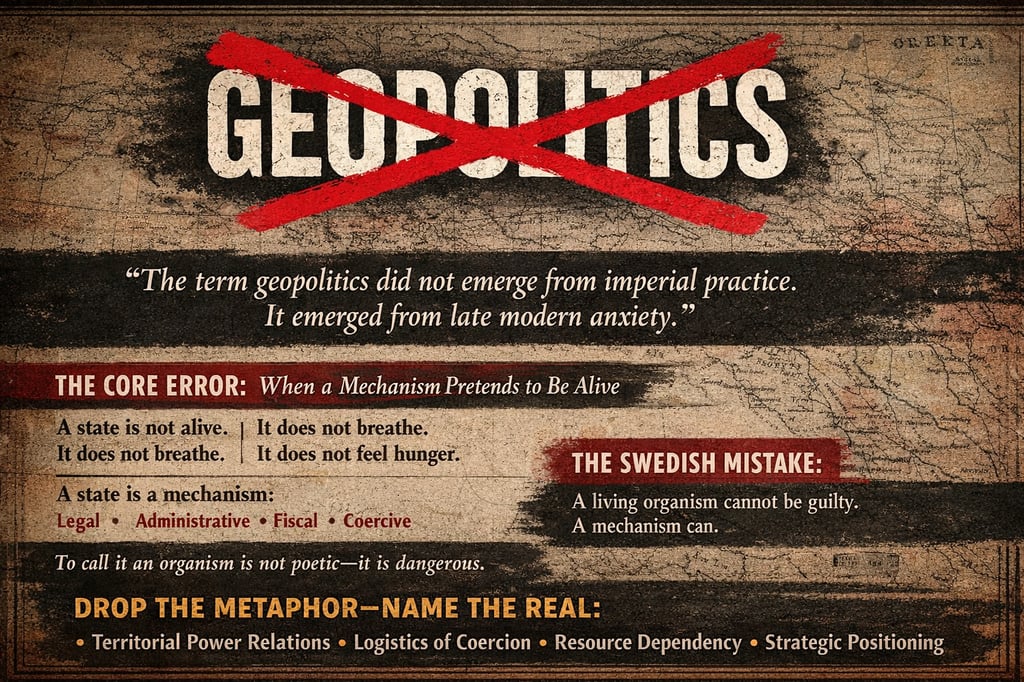
The term geopolitics did not emerge from imperial practice. It emerged from late modern anxiety.
When empires ruled, they did not need metaphors. Power was personal, dynastic, theological, and openly coercive. Rome did not pretend to be an organism. Byzantium did not claim a metabolism. The Ottoman state did not describe itself as a living body searching for “space.” Empires acted; they did not theorize themselves into nature.
The invention of geopolitics marks something else entirely: the moment when power lost its sacred grounding and desperately searched for a biological alibi.
This alibi was supplied at the turn of the 20th century by a well-meaning but deeply misleading formulation from the Swedish political imagination, most famously articulated by Rudolf Kjellén. His claim—that the state is a living organism embedded in geographic space—was not a discovery. It was a symptom.
The Core Error: When a Mechanism Pretends to Be Alive
A state is not alive.
It does not breathe. It does not feel hunger. It does not possess instincts. It does not suffer pain.
A state is a mechanism:
legal
administrative
fiscal
coercive
procedural
To call it an organism is not poetic—it is dangerous.
The metaphor quietly performs a sleight of hand:
if the state is alive, it must survive;
if it must survive, it may expand;
if it expands, violence becomes biological necessity rather than political choice.
Thus conquest is rebranded as metabolism. Borders become skin. War becomes digestion.
This is not analysis. This is mythology with a clipboard.
Why This Could Only Happen After Secularization
The irony is sharp: geopolitics presents itself as scientific precisely because religious legitimacy collapsed.
Once divine right vanished, once kings stopped being God’s deputies, power had to justify itself in new ways. Biology—new, fashionable, authoritative—became the substitute theology.
Geopolitics is therefore not pre-modern wisdom. It is post-religious compensation.
The 20th century did not discover that geography matters. It discovered that power, stripped of sacred language, needed naturalized excuses.
And so the state was baptized—not in holy water—but in pseudo-Darwinian prose.
The Swedish Mistake (With Affection, But Firmly)
There is something distinctly Nordic about believing that if one names a system carefully enough, it will behave responsibly.
The Swedish contribution to political language has often aimed at neutrality, rationality, and administrative clarity. Yet here, in the case of geopolitics, that impulse produced the opposite: a concept so vague it could justify anything, and so organic it could not be held morally accountable.
A living organism cannot be guilty. A mechanism can.
Calling the state an organism is therefore not an innocent metaphor—it is an ethical escape hatch.
What We Should Say Instead
Drop geopolitics.
Say instead:
territorial power relations
logistics of coercion
infrastructure and constraint
administrative reach
resource dependency
strategic positioning
These terms do not pretend the state has a soul. They keep responsibility where it belongs: with human decision-makers.
Final Note
Geopolitics is not wrong because geography is irrelevant. It is wrong because metaphor replaced mechanism.
Empires did not need geopolitics. They needed roads, grain, ships, taxes, and soldiers.
We should be no more mystical than they were.